
Add Objects With Auto Dashboard
Strategy One (August 2025) introduces a preview feature, Auto Dashboard 2.0, which has been enhanced to improve responses and the design process. Beginning in Strategy One (September 2025), Auto Dashboard 2.0 is available out-of-the-box.
For more information on the enhancements, see Auto Dashboard 2.0 Enhancements.
Use Auto Dashboard to create and edit objects beyond visualizations on your dashboard pages:
-
Derived metric (Strategy One (April 2026))
-
Filter
-
HTML container (Strategy One (November 2025))
-
Image box (Strategy One (November 2025))
-
Navigation panel (Strategy One (May 2026))
-
Panel stack and information window (Strategy One (June 2026))
-
Parameter selector (Strategy One (April 2026))
-
Selector (Strategy One (April 2026))
-
Shape
-
Text box
-
Rich text box (Strategy One (December 2025))
Auto Dashboard's creation and editing capabilities help you iterate quickly on your dashboard pages, allowing you to focus on insights rather than technical implementation details.
Add Objects with Auto Dashboard
- In Library, create a new dashboard or edit an existing dashboard.
- To edit an existing dashboard, right-click the dashboard and select Edit.
The dashboard must contain at least one dataset.
-
If the Auto Dashboard icon
 is not displayed in the sidebar, as shown below, enable Auto Dashboard.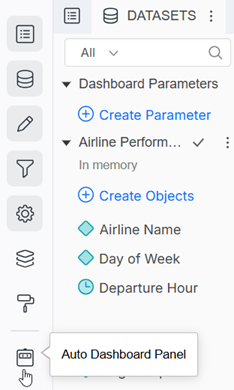
-
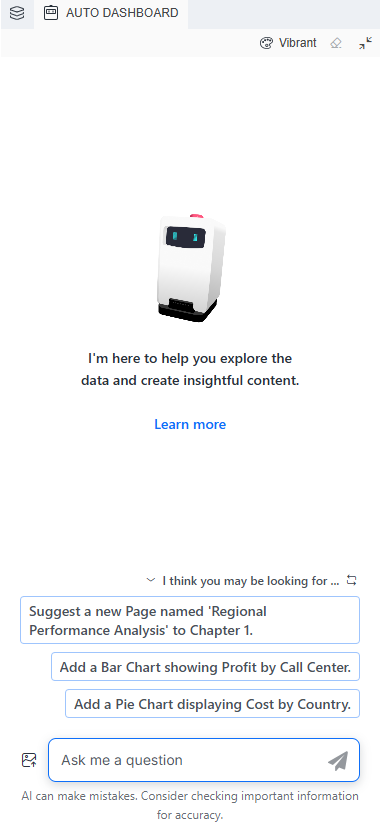
If the Auto Dashboard panel is not displayed, click the Auto Dashboard icon
in the sidebar.
The Auto Dashboard panel displays a list of AI-generated content suggestions. The suggestions depend on the attributes and metrics in the dashboard's dataset.
-
Beginning in Strategy One (January 2026), you can display the Auto Dashboard panel as a floating window, providing more space for the dashboard canvas. Click the Switch to Floating Panel icon
 in the panel's toolbar.
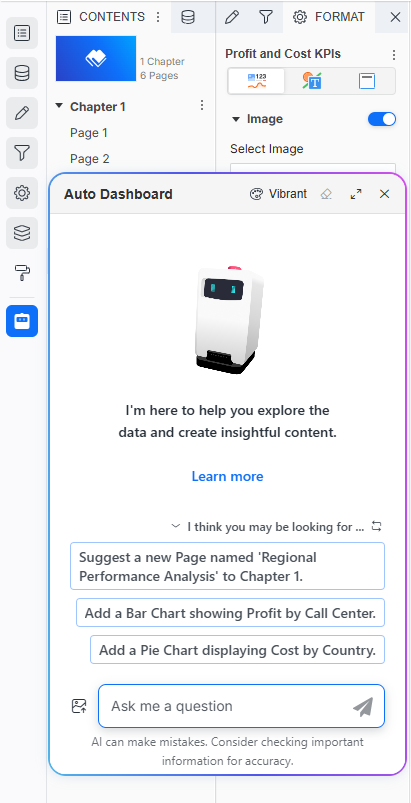 Click here for steps to work with the floating Auto Dashboard panel.
-
You can drag the floating panel to a different location on the dashboard and resize it.
-
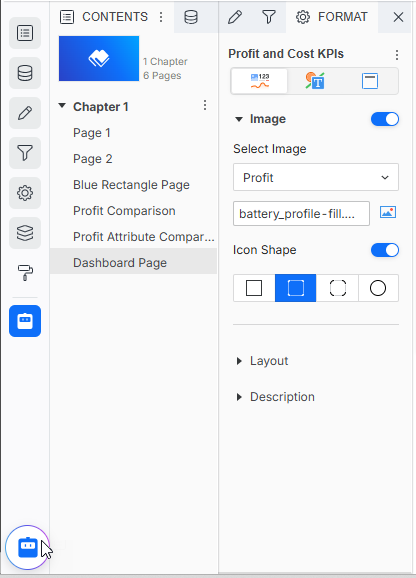
To minimize the panel to an icon at the bottom of the sidebar, click Close X. To restore it, click the icon
 .
.
-
To return the panel to the side panel, click the Switch to Side Panel icon
 in the panel's toolbar.
-
-
To create a derived metric, in the Auto Dashboard panel, type natural language instructions to describe the metric. You can:
-
Create the metric definition
-
Add a filter to the metric to create a conditional metric
-
Define the number formatting
-
-
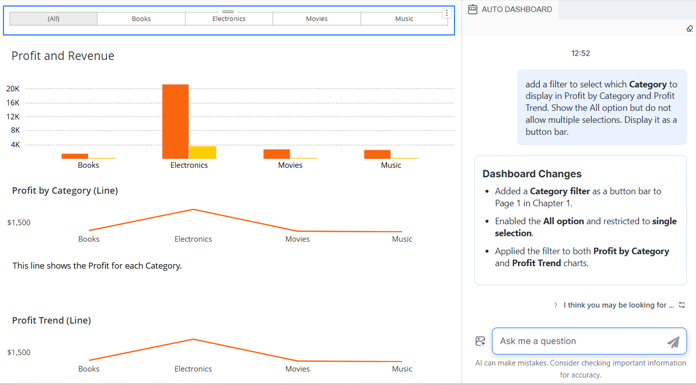
To create a filter, in the Auto Dashboard panel, type natural language instructions to describe the filter. You can:
-
Filter on attribute elements or metric values
-
Define the display style (drop-down, slider, and so on)
-
Adjust the operator for a metric filter (equals, greater than, and so on)
-
Specify which visualizations to filter
-
-
Use Auto Dashboard to display a filter's targets in the Auto Dashboard panel.
-
To create a selector, in the Auto Dashboard panel, type natural language instructions to describe the selector. You can:
-
Choose which metrics or attributes to display in the selected visualization
-
Define the display style (drop-down, slider, and so on)
-
Specify which visualizations to target
-
-
To create an element or object parameter selector, in the Auto Dashboard panel, type natural language instructions to describe the selector. You can create a parameter that lets the user select:
-
One value to display from a list of attribute elements
-
Multiple attributes or metrics to display
-
Define the display style (drop-down, slider, and so on)
-
Specify which visualizations to target
-
-
To create an HTML container, in the Auto Dashboard panel, type natural language instructions to describe the HTML container.
-
To create an image container, in the Auto Dashboard panel, type natural language instructions to describe the image, including the path to the image.
-
To create a navigation panel, in the Auto Dashboard panel, type natural language instructions to describe the panel. For example, you can specify whether chapters display as a drop-down list or flat list or if only pages display.
-
A navigation panel displays a navigable table of contents on every page in the dashboard. Use it to easily and quickly view the dashboard's structure and navigate through it.
-
-
To create a panel stack, in the Auto Dashboard panel, type natural language instructions to describe the panel stack. You can:
-
Describe the panels to create on the panel stack, including panel names and the objects (visualizations, filters, text, and so on) on each panel
-
Create a panel selector
-
Add a panel to an existing panel stack
-
Remove panels
-
Add objects to a panel
-
Remove objects from a panel
-
Add a panel stack to an existing panel
-
-
To create an information window, in the Auto Dashboard panel, type natural language instructions to describe the information window. You can:
-
Describe the panels to create on the information window, including panel names and the objects (visualizations, filters, text, and so on) on each panel
-
Select the trigger for the information window (a visualization, image, or text box)
-
Add a panel to an existing information window
-
Remove panels
-
Add objects to a panel
-
Remove objects from a panel
-
-
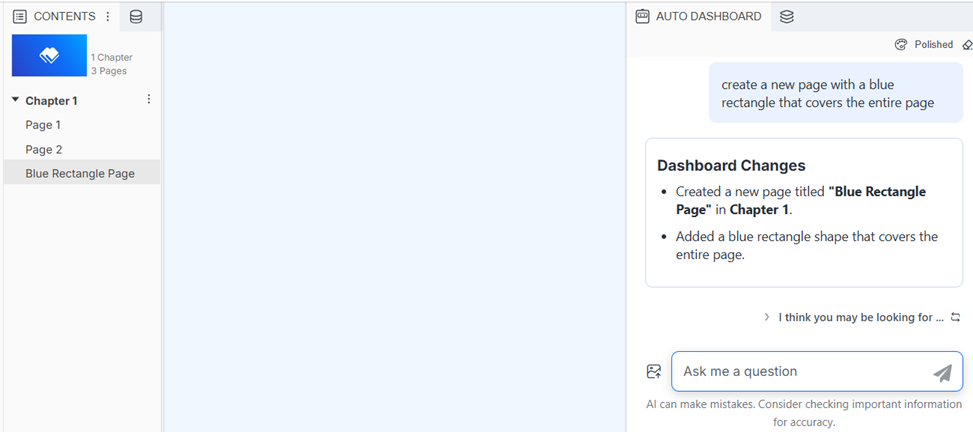
To create a shape, in the Auto Dashboard panel, type natural language instructions to describe the shape. You can:
-
Indicate what type of shape (rectangle, circle, and so on)
-
Size the shape
-
-
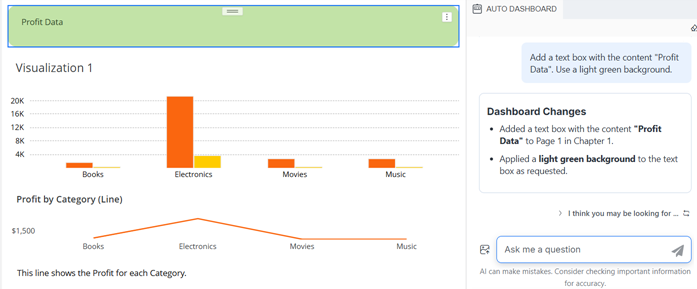
To create a text box, in the Auto Dashboard panel, type natural language instructions to describe the text box. You can:
-
Describe the text to display
-
Customize the background color of the text box
-
-
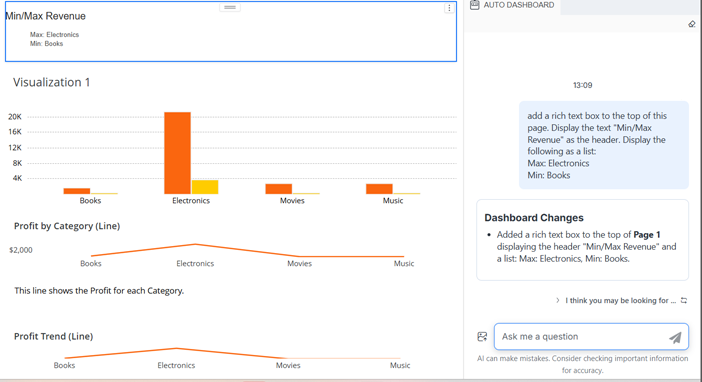
To create a rich text box, in the Auto Dashboard panel, type natural language instructions to describe the text box. You can:
-
Describe the text to display
-
Describe the format to use, such as headers, bold, and lists
-
-
Use Auto Dashboard to rewrite, replace, remove, or add text in a text field or rich text field.
-
Use Auto Dashboard to:
-
Move, align, and resize objects
-
Delete objects
-
Rename objects
-
-
Use Auto Dashboard to change an object's background color.
-
You can ask Auto Dashboard for ideas on what you can do. For example, type, "What can I can do with a filter?".
Save the Dashboard
-
Do one of the following:
-
To save the dashboard and continue editing, click Save and select Save.
-
To save the dashboard, exit editing, and view the dashboard, click Save and select Save and View.
-