
Import Data from Google BigQuery (Native API)
Create an OAuth App in Google
-
Sign in to
https://console.cloud.google.com/apis/credentials. -
Click APIs & Services > Credentials > Create credentials.
-
Choose OAuth client ID.
-
In Application Type, choose Web application.
-
Type an application name and click Save.
-
Copy Client ID and Client secrets which you will use to create your Google BigQuery data source.
-
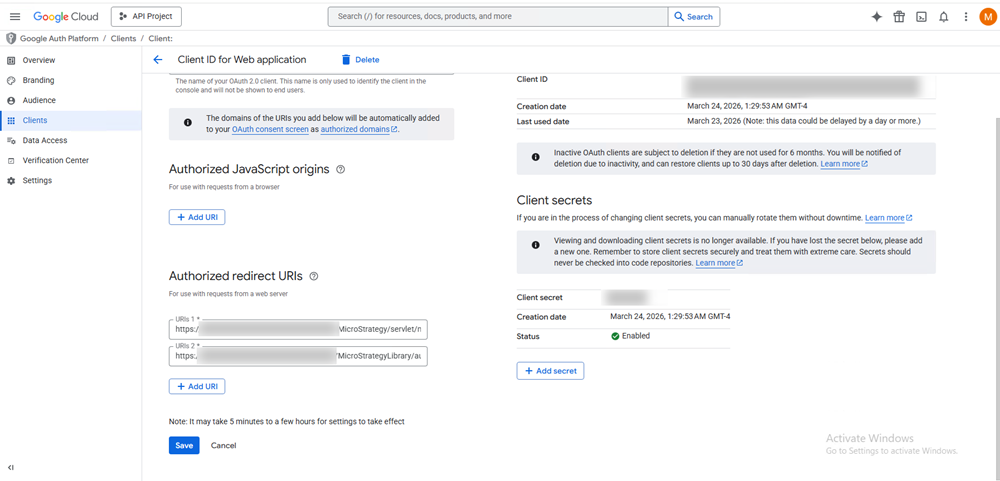
Under Authorized redirect URIs, click Add URI and add the callback URL for Web, Library, or Workstation using the following formats:
-
Web redirect URI:
https://<servername>/MicroStrategy/servlet/mstrWeb?evt=3172 -
Library redirect URI:
https://<servername>/MicroStrategyLibrary/auth/DIOAuthRedirect.jsp -
Workstation redirect URI:
http://127.0.0.1
-
-
Click Save.
Create a Google BigQuery (Native API) Data Source
Prior to Strategy (June 2026), you need to configure the Client ID and Client Secret that Google BigQuery provides in Strategy Web or configure the Client ID and Client Secret in Workstation. For more information, see Create an IAM Object with a Generic OAuth Type.
Starting in Strategy (June 2026), you can create multiple Salesforce Reports data sources.
Privileges
To create and edit authentication services, you must have the Configure security settings privilege.
To create and edit data sources, you must have the Create and edit database instances and connections privileges.
Create an Authentication Service in Workstation
-
Open the Workstation window.
- In the Navigation pane, click
 , next to Enterprise Security.
 - Choose an environment.
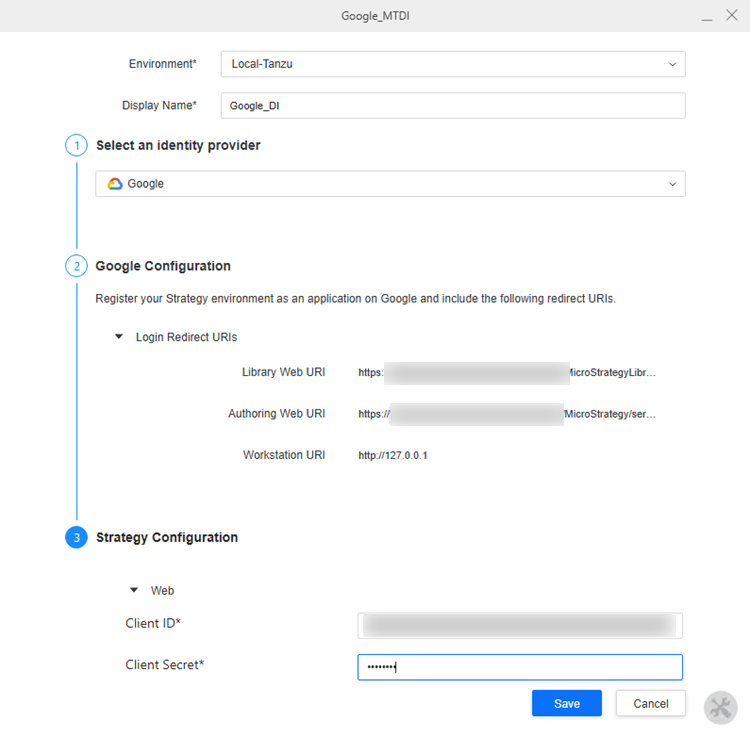
- From the identity provider drop-down, choose Google.
-
Enter the Client ID and Client Secret that you noted as Consumer Key and Consumer Secret above.
The Library Web, Authoring Web, and Workstation URIs automatically populate.
-
Click Save.
Create Google BigQuery (Native API) Data Source
Starting in Strategy (June 2026), you can create multiple Salesforce data sources.
-
If you are using Library:
-
Click Create New and choose Dashboard.
-
Click New Data.
-
Click Create a new data source.
-
-
If you are using Workstation, click
 next to Data Sources.
 -
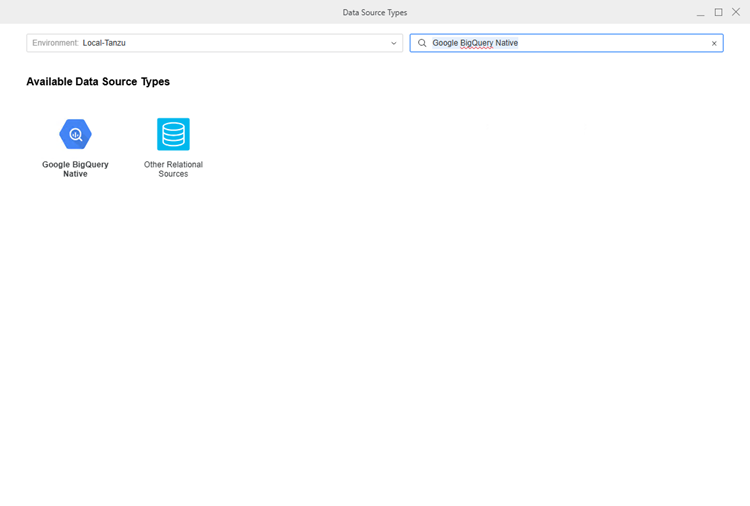
Choose Google BigQuery Native.
-
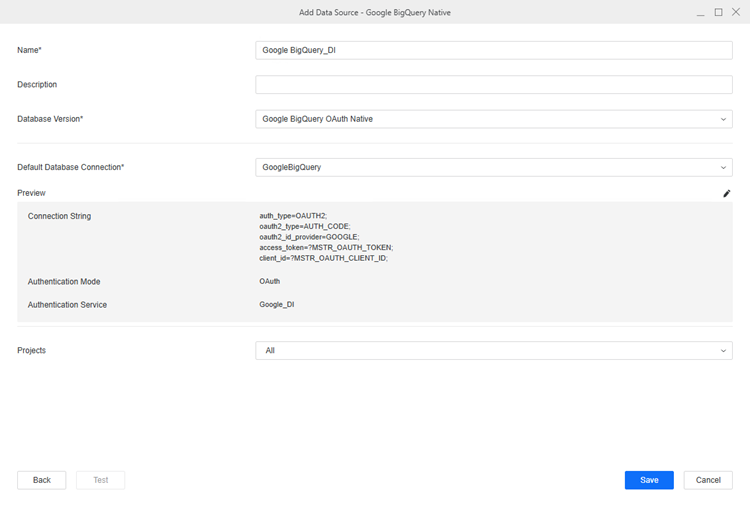
Type a Name and optional Description.
-
Expand Default Database Connection and choose an existing database connection or click Add Database Connection and enter values in the required fields.
-
To create a new database connection, choose the authentication service you created in Create an Authentication Service in Workstation or create a new one.
-
Click Save.
Import Data
After you create a database role, you can import data.
-
If you are using Workstation:
-
Open the Workstation window.
-
In the Navigation pane, click
, next to Datasets. -
Select your environment and project.
-
Choose Data Import Cube and click OK.
-
-
If you are using Library, click Create New and choose Dashboard.
-
Choose the Google BigQuery (Native API) database role.
If this is your first time using the database role, a pop-up displays to login to Google.
-
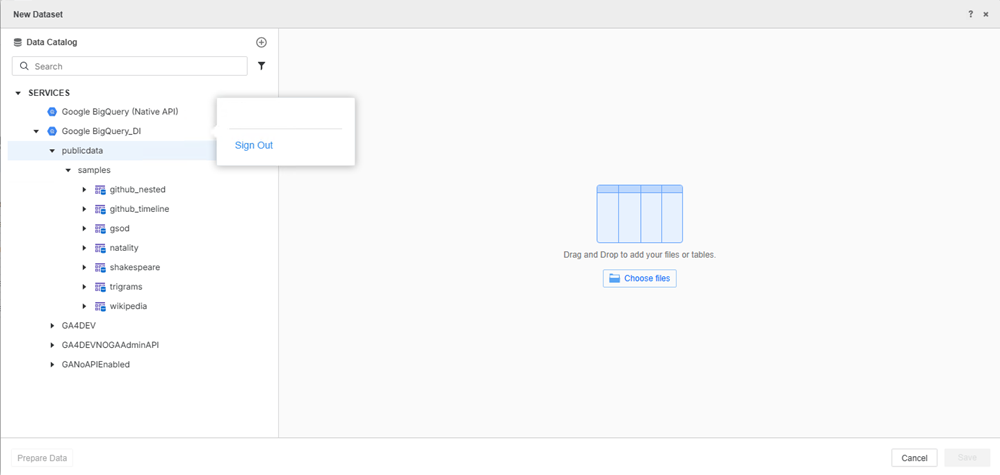
Your Google BigQuery projects and tables display in the left pane.
-
Expand folders to view their tables.
-
To refresh the contents of your Google account, click Refresh.
-
If you need to access files in a different account, hover over the Google account under Services in Strategy, click Sign Out, and log in to the account.
-
You can import Google BigQuery (Native API) data using the following methods:
-
Import data with tables:
-
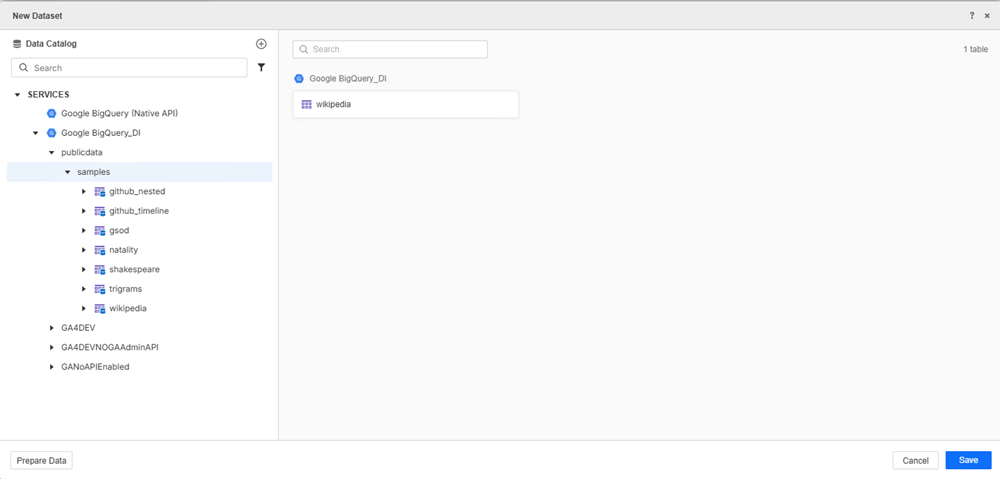
In the left pane, expand the Google BigQuery (Native API) project you want to use.
-
Hover over a table and click add to add it to the right pane.
-
-
Import data with Freeform SQL:
-
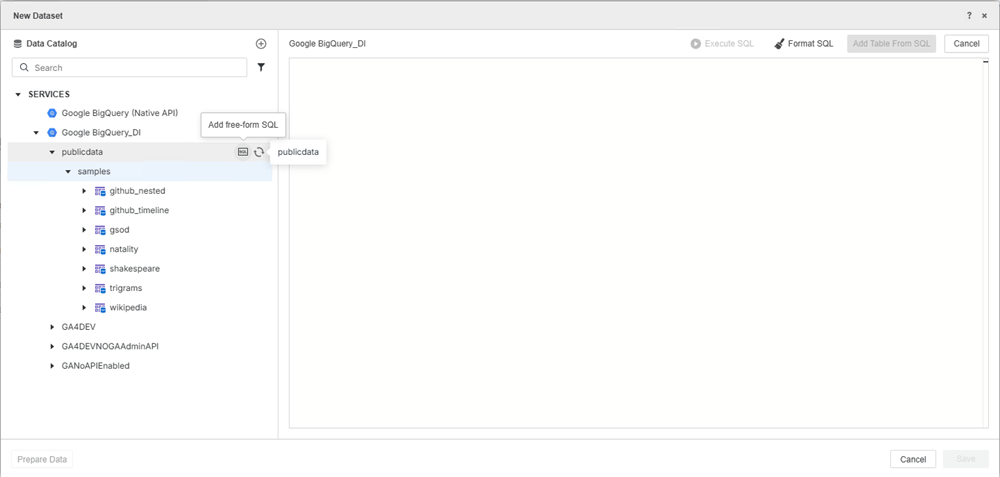
In the left pane, hover over a Google BigQuery (Native API) project you want to use and click Add free-from SQL.
-
Input your SQL and click Add Table from SQL.
-
-
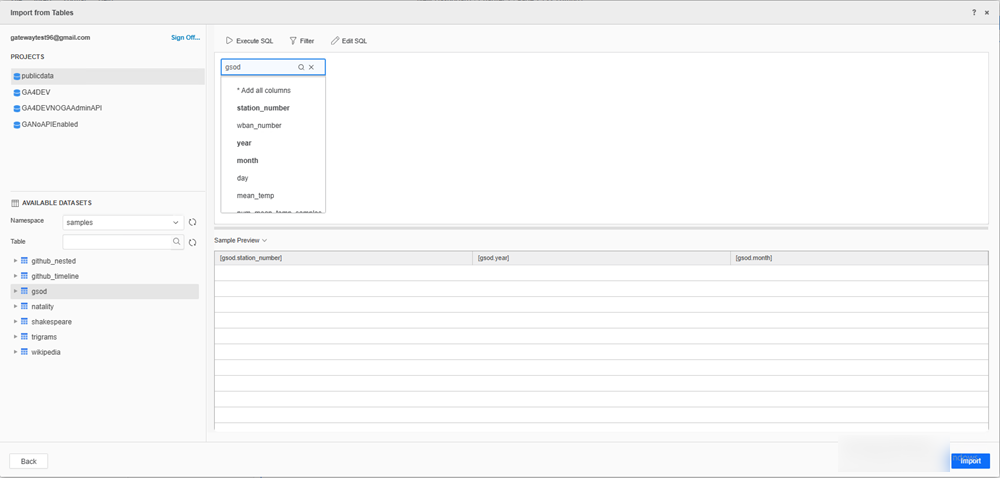
Import data by build query:
-
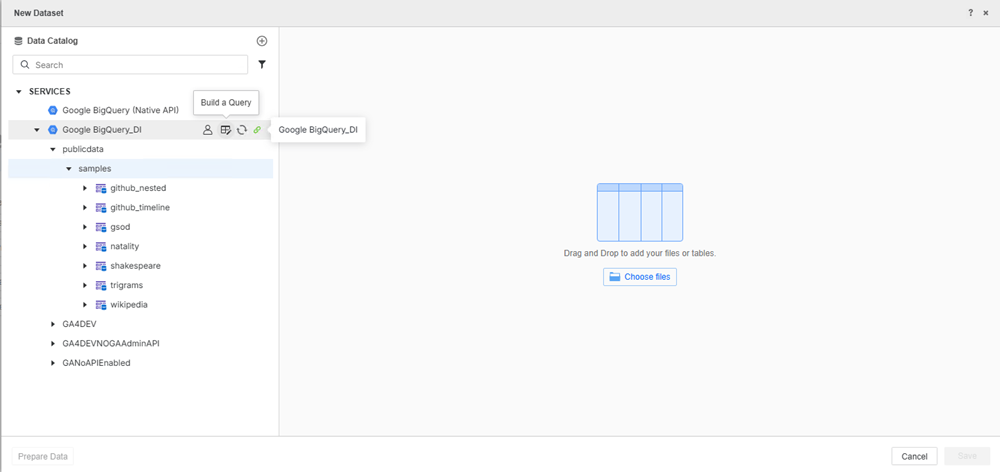
In the left pane, hover over a Google BigQuery account and click Build a Query.
-
Choose a project and table.
-
Select the columns you want to add and click Import.
-
-
-
Click Prepare Data and make any necessary changes.
-
Click Finish if you are adding a new dataset and go to the next step.
or
Click Update Dataset if you are editing an existing dataset and go to the next step.